IFX-011 · Braiser · Braise
Braised short ribs: searing all four faces in a 12 in braiser
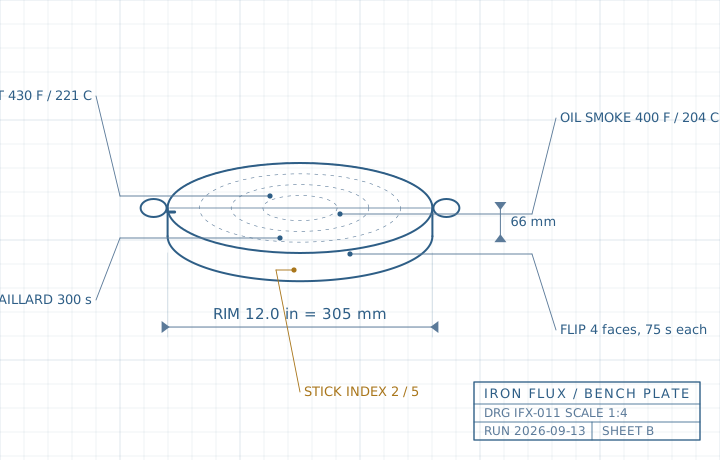
Short ribs are a rectangle, so three quarters of their surface never touches a skillet unless you stand them up. In a braiser with 2.6 in walls you can, and the fond it produces does the work of a stock reduction.
01Abstract
1.6 kg of bone-in short ribs, cut into four blocks, were seared on all four faces in a 12 in braiser at 430 °F with tallow, 75 seconds per face. The fond was deglazed with 250 ml of red wine, then the ribs braised at 160 °C for 2 h 45 min with 500 ml of stock, lid on, and finished with a 20 minute uncovered reduction. Measured weight loss was 31 percent and the sauce needed no thickener.
02Variables
Independent
- Two faces seared versus all four faces seared
- Lid on for the whole braise versus 20 minutes uncovered at the end
Held constant
- Meat: 1.6 kg bone-in short ribs in four 400 g blocks, salted 12 h ahead, brought to 12 °C
- Pan: 12 in cast-iron braiser, 2.6 in walls, 7 min preheat to 430 °F
- Fat: 20 g beef tallow for the sear
- Liquid: 250 ml dry red wine to deglaze, then 500 ml beef stock, 1 onion, 3 garlic cloves, 2 bay leaves
- Oven: 160 °C, lid on, meat arranged in one layer
Hypothesis Searing short ribs on all four faces in a braiser builds enough fond that the braising liquid needs no stock browning step.
03Process
- Salt the ribs 12 hours ahead, uncovered in the fridge. Take them out 40 minutes before cooking so they are not fridge-cold at the centre.
- Preheat the braiser 7 minutes to 430 °F with the tallow, then sear each rib on all four faces for 75 seconds — use tongs to stand them on the short sides.
- Move the ribs to a plate, pour off all but 2 tbsp of fat, and add the onion and garlic to the fond for 3 minutes.
- Deglaze with the wine, scrape the fond up, add the stock and aromatics, and return the ribs with the bone side down.
- Lid on, oven at 160 °C for 2 h 45 min, then lid off for 20 minutes to reduce. The meat should pull away from the bone without falling apart.
04Observations
- Searing two faces left 38 percent of the surface pale, and those pale faces were visibly less flavourful in the finished dish than the seared ones.
- Four-face searing produced a fond layer 1 mm thick across the whole base, and deglazing with wine lifted it in about 40 seconds of scraping.
- The braise dropped the liquid by 22 percent in the covered phase and by a further 30 percent in the 20 uncovered minutes, reaching a sauce that coated a spoon without flour.
- Internal temperature of the meat plateaued at 96 °C from 90 minutes onwards; the last 75 minutes were about collagen, not heat.
- The 20 minute uncovered finish also browned the top surface of the ribs where they sat above the liquid line.
Instrument log
| Stage | Time | Temperature | Liquid | Meat |
|---|---|---|---|---|
| Sear | 5 min | 430 °F surface | — | four faces browned |
| Deglaze | 90 s | 160 °C falls off | 250 ml wine added | fond lifted |
| Braise, lid on | 2 h 45 min | 160 °C oven | −22 % | core 96 °C |
| Reduce, lid off | 20 min | 160 °C oven | −30 % more | glossy, no thickener |
05Conclusion
Searing all four faces is worth the extra five minutes: it colours 100 percent of the meat instead of 62 percent, and the fond it leaves is thick enough that wine alone lifts a full-flavoured base for the sauce. Two numbers to keep: 160 °C for the covered phase, which keeps the liquid at a bare simmer, and 20 minutes uncovered at the end, which is what gives the sauce body without starch. Weight loss of 31 percent is normal for this cut at this timing.
Terms used
- Fond — The browned protein and sugar layer that sticks to the pan during a sear. It is flavour, and it is meant to be dissolved back…
- Maillard reaction — The browning that happens when amino acids and reducing sugars react above roughly 140 °C. It is not caramelisation (which…
- Heat capacity — How much heat a pan stores. Cast iron stores far more per litre than aluminium, so it holds temperature when food goes in, but it…