IFX-003 · 12 in skillet · Reverse sear
Reverse-seared 2 in ribeye finished in a dry 12 in skillet
The 12 in pan is dry, the steak is dry, and the whole finish takes two and a half minutes. Oil goes in only for the last 30 seconds, and by then the crust is already built.
01Abstract
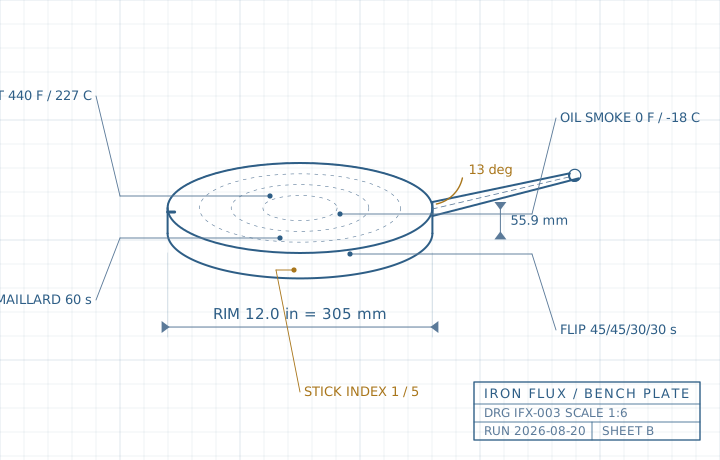
A 640 g bone-in ribeye, 50 mm thick, was brought to 46 °C core in a 120 °C oven on a wire rack, rested 8 minutes, then finished in a dry 12 in cast-iron skillet at 440 °F. Total pan time was 150 s in a 45/45/30/30 rhythm, with 20 g of cold butter added at 90 s. Core temperature rose from 46 °C to 54 °C, which is the whole point of the method: the pan builds crust, the oven already did the cooking.
02Variables
Independent
- Finish surface: dry iron versus 1 tsp oil laid down before the steak
- Number of flips in the 150 s finish: two flips versus four
Held constant
- Steak: 640 g bone-in ribeye, 50 mm, 30-day dry-aged, salted 24 h ahead and left uncovered in the fridge
- Oven stage: 120 °C on a wire rack to 46 °C core, then 8 min rest under foil
- Pan: 12 in bare cast iron, 6 min preheat to 440 °F, no moving
- Butter: 20 g cold, added at 90 s in the four-flip version only
- Probe: instant-read at the geometric centre, away from the bone
Hypothesis A dry preheated iron gives a cleaner crust on a reverse-seared ribeye than an oiled pan, because there is no liquid fat to cool the contact patch.
03Process
- Salt the steak 24 hours ahead and leave it uncovered on a rack in the fridge so the surface dries to a tacky film.
- Cook it in a 120 °C oven on a wire rack to 46 °C core — roughly 55 minutes for this thickness — then rest 8 minutes under loose foil.
- Preheat the dry skillet 6 minutes to 440 °F while the steak rests. Wipe the resting board of any liquid; the surface must go in dry.
- Lay the steak in and start the timing: flip at 45, 90, 120 and 150 s. Add butter at 90 s and tilt the pan to spoon it over the crust.
- Pull at 150 s, check the core reads 54 °C, and rest 5 minutes on a warm plate before slicing against the grain.
04Observations
- The dry pan produced a hard, even mahogany crust across the whole surface with no pale gaps; contact was complete within 20 s.
- With 1 tsp of oil added first, the oil pooled under the steak and the crust came out slightly darker at the edges but mottled in the middle.
- Four flips beat two: the two-flip version had a 15 mm grey band under the crust, the four-flip version about 8 mm.
- Butter at 90 s browned in 20 s and left a hazelnut smell; added at 30 s instead it simply burnt by 70 s.
- The pan smoked at 130 s in the butter stage — that smoke is milk solids, not the oil, and it stops the moment the pan comes off the heat.
Instrument log
| Time | Action | Core | Surface note |
|---|---|---|---|
| 0 s | steak in, dry iron | 46 °C | full contact in 20 s |
| 90 s | flip 2, add butter | 49 °C | crust mahogany |
| 120 s | flip 3 | 52 °C | butter browning |
| 150 s | out | 54 °C | rest 5 min |
05Conclusion
For a 50 mm steak the oven does the cooking and the iron does only the crust, so the finish is a 150-second job and the pan can stay dry for the first 90 seconds. Four flips in that window halve the grey band, and butter belongs at 90 seconds — earlier and it burns before the crust is done. Total weight loss on the 640 g steak was 118 g, of which most was water driven off in the oven stage, not in the pan.
Terms used
- Maillard reaction — The browning that happens when amino acids and reducing sugars react above roughly 140 °C. It is not caramelisation (which…
- Emissivity — How efficiently a surface radiates heat. A dark, seasoned cast-iron surface radiates more than a shiny one, which is why a…
- Heat capacity — How much heat a pan stores. Cast iron stores far more per litre than aluminium, so it holds temperature when food goes in, but it…