IFX-001 · 12 in skillet · Direct sear
Preheat window of a 12 in skillet: 5, 8 or 11 minutes
One 12 in skillet, one burner setting, one oil. The only thing changed was how long the empty pan sat on the heat, and the difference in browning time was 45 seconds.
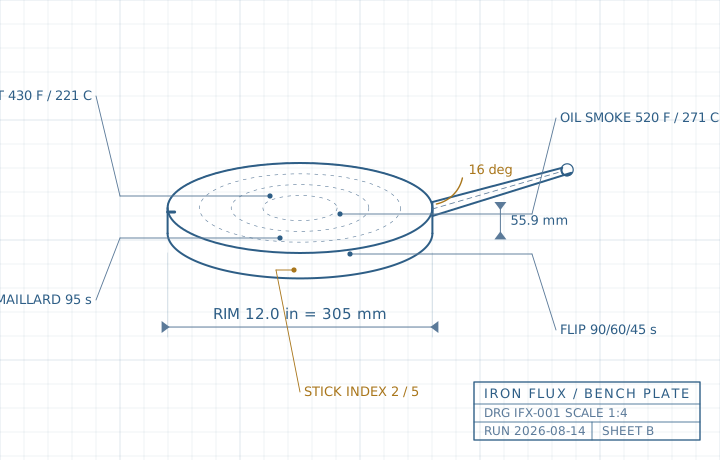
01Abstract
A 12 in cast-iron skillet was preheated on the same medium-high gas setting for 5, 8 and 11 minutes, with surface temperature logged every minute by infrared thermometer. A 180 g flat iron steak was then seared in avocado oil at each temperature and the time to first persistent brown colour recorded. Surface temperature went 300 °F at 2 min, 430 °F at 6 min and 455 °F at 11 min; browning time fell from 140 s to 95 s to 88 s. Past 6 minutes the pan gains 25 °F but the steak gains 7 seconds, while the polymerised seasoning layer takes visibly more heat stress.
02Variables
Independent
- Preheat duration: 5 min, 8 min or 11 min at a fixed dial position
- Recorded surface temperature at the moment the meat went in
Held constant
- Pan: bare cast iron, 12 in, 2.2 in wall, no enamel
- Burner: gas, outer ring only, dial held at the 6-of-10 mark
- Oil: avocado, 1 tsp, added after preheat and swirled for 5 s
- Steak: 180 g flat iron, 22 °C core, patted dry, salted 40 min before
- Aim point: infrared gun at pan centre, 2 cm in from the rim
Hypothesis A 12 in skillet keeps climbing past 5 minutes, but the extra surface temperature buys less browning time than the seasoning layer pays for.
03Process
- Wipe the cold pan with a dry cloth and set it on the outer ring at the 6-of-10 mark. Start the timer and do not move the pan.
- At 2, 4, 6, 8 and 11 minutes, take an infrared reading at the centre of the cooking surface and write it down. Aim from 20 cm and hold the gun perpendicular.
- At the chosen minute, add 1 tsp avocado oil and swirl for 5 s; it should ripple and thin out immediately without smoking hard.
- Lay the steak down away from you and start a second timer. Do not press and do not move it for 90 s.
- Flip at 90 s, 150 s and 195 s cumulative (the 90/60/45 rhythm), then pull to a rack and rest 6 min before slicing.
04Observations
- 5 min preheat: the oil moved slowly, the steak stuck at two points and left a pale grey ring; first real colour only at 140 s.
- 8 min preheat: oil thinned in under 2 s, the steak released by itself at the first flip, colour at 95 s.
- 11 min preheat: colour at 88 s, but the pan smoked lightly at the edges 40 s after the meat went in even with a 520 °F oil, and the seasoning dulled to a matte grey-brown.
- The handle was already too hot to hold bare at 5 minutes; at 8 minutes a folded dry towel was needed.
- Pan temperature at the 2 cm ring read 20–35 °F cooler than centre at every point, which is why the steak was placed centre-first.
Instrument log
| Preheat | Surface at meat-in | Oil behaviour | First colour | Seasoning after |
|---|---|---|---|---|
| 5 min | 392 °F / 200 °C | slow ripple | 140 s | unchanged, glossy |
| 6 min | 430 °F / 221 °C | thins in 2 s | 95 s | unchanged, glossy |
| 8 min | 441 °F / 227 °C | thins at once | 101 s | slight matte patch |
| 11 min | 455 °F / 235 °C | smokes at edges | 88 s | matte grey-brown, needs re-oil |
05Conclusion
Six minutes at the 6-of-10 mark on a 4.2 kW gas ring is the useful ceiling for this pan. Between 6 and 11 minutes the surface only gains 25 °F and browning gains 7 seconds, but the polymerised layer visibly dulls and takes on the grey matte look of a stressed seasoning. If your burner is smaller, preheat to the temperature — 430 °F at the centre — not to the clock: the same 6 minutes on a 2.6 kW ring reached only 385 °F.
Terms used
- Maillard reaction — The browning that happens when amino acids and reducing sugars react above roughly 140 °C. It is not caramelisation (which…
- Smoke point — The temperature at which a fat breaks down visibly and starts giving off acrid volatiles. Refined oils sit higher (rice bran…
- Heat capacity — How much heat a pan stores. Cast iron stores far more per litre than aluminium, so it holds temperature when food goes in, but it…