IFX-009 · 12 in skillet · Direct sear
Crisp-skin snapper: what a 3.5 minute skin-side sear costs in stick index
Fish is the hardest thing to sear in cast iron because the skin is thin, wet and full of collagen. This run pinned down when the fillet lets go by itself, and what happens if you force it.
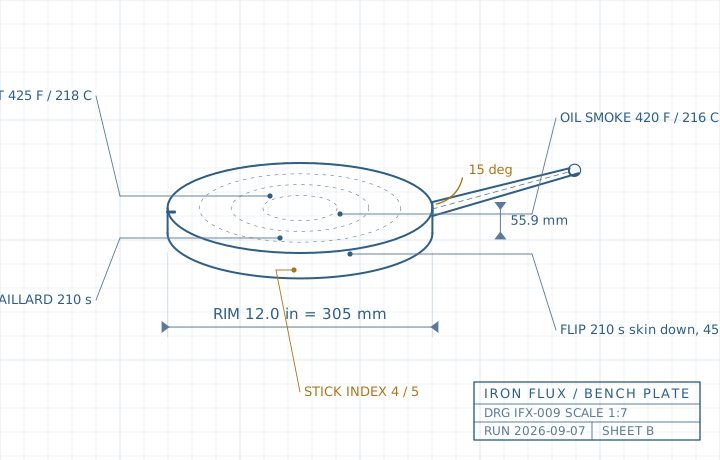
01Abstract
Four 180 g skin-on snapper fillets were seared skin-side down in a 12 in skillet at 425 °F with 1 tsp grapeseed oil. One fillet was lifted every 45 seconds to test release; the others were left for 150, 210 and 270 seconds. Only the 210-second fillet released with no resistance and no skin loss; forcing a lift at 150 seconds tore 40 percent of the skin away and left it on the iron.
02Variables
Independent
- Skin-side contact time before the flip: 150 s, 210 s or 270 s
- Lifting to test release every 45 s versus leaving the fillet untouched
Held constant
- Fish: 180 g skin-on snapper fillets, scaled, patted dry, salted 15 min before and wiped again
- Pan: 12 in bare cast iron, 6 min preheat to 425 °F, 1 tsp grapeseed oil
- A light press with a fish spatula for the first 20 s only, to stop curling
- Flesh side 45 s at the end, no basting
- Same burner ring at 6 of 10 throughout
Hypothesis Skin-on fish releases from cast iron at a predictable moment, and the release is the signal that the skin is crisp — not the timer.
03Process
- Dry the skin with a paper towel, salt it 15 minutes ahead, then wipe the drawn moisture off again before it goes in.
- Preheat 6 minutes to 425 °F, add 1 tsp grapeseed oil, and lay the fillet in skin down, away from you.
- Press gently with a fish spatula for 20 seconds only. After that, hands off.
- Do not test the release before 180 seconds. At 210 seconds, slide the spatula under the tail end; it should go in with no resistance.
- Flip for 45 seconds flesh side down, then serve skin up immediately, before the skin steams itself soft.
04Observations
- At 150 s the fillet was still welded across the middle: lifting it tore a 40 percent strip of skin away and left it stuck to the iron.
- At 180 s the edges were free but the centre still held; the spatula met a soft resistance.
- At 210 s the fillet slid free as one piece; the skin was amber across the whole surface with no pale patches.
- At 270 s the skin was dark and slightly bitter at the thin tail, and the flesh had gone to 68 °C.
- Pressing for longer than 20 s did nothing except squeeze moisture out from under the skin — the two fillets pressed for 60 s had visibly wetter pan surfaces.
Instrument log
| Skin-down time | Release | Skin left on pan | Skin colour | Flesh core |
|---|---|---|---|---|
| 150 s | centre welded | 40 % torn away | pale, patchy | 52 °C |
| 180 s | centre still held | 8 % | amber at edges | 56 °C |
| 210 s | free, one piece | 0 % | even amber | 60 °C |
| 270 s | free but dry | 0 % | dark at tail, bitter | 68 °C |
05Conclusion
For a 180 g fillet on a 425 °F cast-iron surface, 210 seconds skin-side down is the release point, and the release is the doneness signal: the skin has finished bonding to the iron and finished crisping at the same moment. Testing earlier is what causes torn fillets — a spatula forced under welded skin takes the skin with it. Press for 20 seconds and then leave it completely alone, and serve skin-up within a minute so it does not steam.
Terms used
- Fond — The browned protein and sugar layer that sticks to the pan during a sear. It is flavour, and it is meant to be dissolved back…
- Maillard reaction — The browning that happens when amino acids and reducing sugars react above roughly 140 °C. It is not caramelisation (which…
- Polymerization — The process by which thin films of oil, heated past their smoke point, cross-link into a hard, smooth, bonded layer on iron. That…