IFX-004 · 8 in skillet · Oven finish
Fried egg in an 8 in skillet: 300, 340 and 380 °F surface
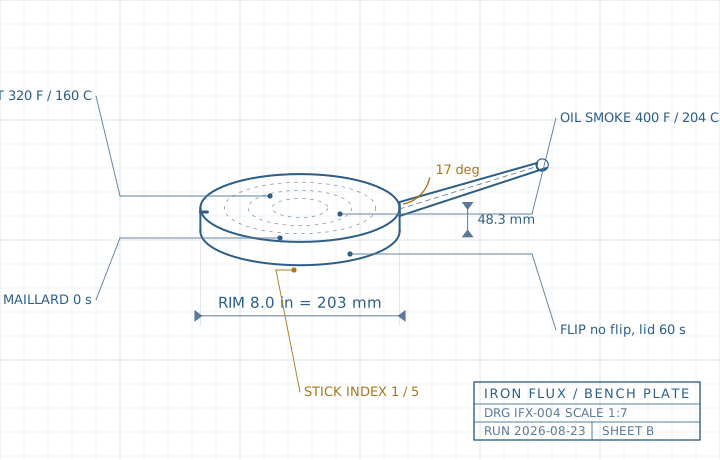
An 8 in skillet is the smallest pan in the rack and the fastest to overshoot. Held at 340 °F it beats any non-stick pan I have used; at 380 °F it welds the egg to the iron.
01Abstract
Nine eggs were fried one at a time in an 8 in cast-iron skillet at three surfaces: 300 °F, 340 °F and 380 °F, with 1 tsp canola oil in each case. The pan was brought to temperature on the inner ring at low dial and the temperature re-checked before every egg. Stick index was scored after lifting with a thin steel spatula; a lid was used for the last 60 seconds of each egg to set the white.
02Variables
Independent
- Surface temperature at the moment the egg went in: 300 °F, 340 °F or 380 °F
Held constant
- Pan: 8 in bare cast iron, inner ring, low dial, 4 min preheat
- Fat: 1 tsp canola oil, swirled for 3 s
- Egg: 58 g large, fridge-cold, cracked into a cup and slid in from the edge
- No salt until after plating; lid on for the final 60 s
- Lift test: thin steel spatula slid flat under the yolk, scored 1–5
Hypothesis Eggs stick because the pan is too cold or too hot, not because the seasoning is thin; 320 to 340 °F is the window where nothing sticks.
03Process
- Preheat the empty pan on the inner ring at low for 4 minutes, then read the surface and adjust the dial by a quarter turn until the target is held for 30 s.
- Add 1 tsp canola and swirl for 3 seconds; the oil should coat thinly and show faint movement, not shimmer hard.
- Crack the egg into a cup and slide it in from the rim so the white lands as one piece instead of splashing.
- Leave it alone for 90 seconds, then cover with a lid for 60 seconds to set the top of the white.
- Slide the spatula flat under the white and lift. Score how much residue is left on the iron and wipe the pan before the next egg.
04Observations
- 300 °F: the white spread and stayed translucent for 70 s, the yolk took 3 min 20 s to set; release was clean but the edge was pale and rubbery.
- 340 °F: white opaque in 35 s, lacy brown edge in 70 s, lid 60 s, and the egg slid onto the plate with no spatula pressure at all.
- 380 °F: the white bubbled hard at the edge within 10 s, and three patches tore loose at the lift, leaving a pale film on the iron.
- The 380 °F pan needed a 60-second rest off the heat before the next egg, which is why batch cooking eggs on high always degrades.
- Canola at 340 °F never smoked; at 380 °F it smoked lightly from 40 s onward, which is the practical sign that the pan is above the oil's comfortable range.
Instrument log
| Surface | White set | Lacy edge | Lift | Stick index |
|---|---|---|---|---|
| 300 °F / 149 °C | 70 s, translucent | none | clean | 1 / 5 |
| 340 °F / 171 °C | 35 s, opaque | at 70 s | slides free | 1 / 5 |
| 380 °F / 193 °C | 18 s, bubbling | at 25 s | 3 patches tear | 4 / 5 |
05Conclusion
The non-stick reputation of well-seasoned iron is really a temperature claim: 340 °F holds the egg on a thin film of oil without welding it, and the same pan at 380 °F will stick even with a good seasoning layer. Use the inner ring at low and check the surface with a gun the first few times; once you know the dial position, the gun is optional. Two eggs at once in an 8 in pan drops the temperature by about 30 °F, so add 20 seconds to the timing rather than turning the dial up.
Terms used
- Polymerization — The process by which thin films of oil, heated past their smoke point, cross-link into a hard, smooth, bonded layer on iron. That…
- Smoke point — The temperature at which a fat breaks down visibly and starts giving off acrid volatiles. Refined oils sit higher (rice bran…
- Thermal shock — Rapid, uneven temperature change that makes a pan or its coating crack or warp. Cast iron itself takes it better than enamel…