IFX-005 · Dutch oven · Bake
No-knead bread in a preheated Dutch oven: lid off at 25 vs 30 minutes
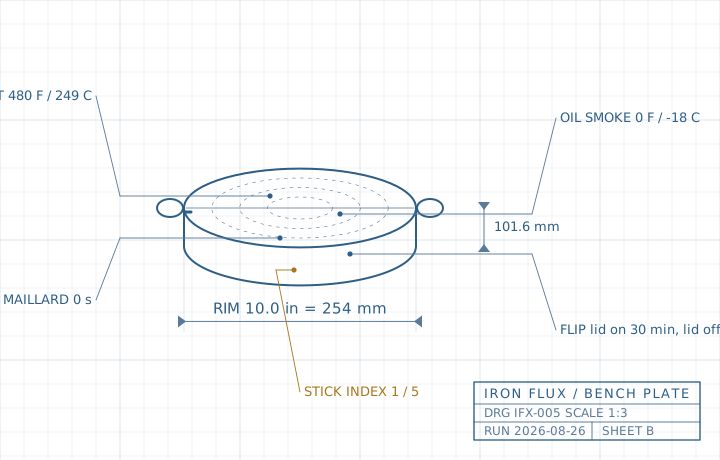
The Dutch oven is the only piece of cast iron that does as much work with the lid on as with the lid off. This run tests when to take the lid off, because that single decision controls crust thickness.
01Abstract
Two 500 g no-knead loaves (75 percent hydration, 18 h cold ferment) were baked in a preheated 10 in Dutch oven at 240 °C. Loaf A had the lid removed at 25 minutes, loaf B at 30 minutes, and both finished for a further 15 minutes open. Core temperature was tracked with a probe; crust thickness was measured on a cooled slice with calipers. Loaf B sprang 8 mm higher and its crust measured 3.1 mm against 4.2 mm for loaf A.
02Variables
Independent
- Lid-off moment: 25 minutes or 30 minutes into the bake
- Total lidded steam time
Held constant
- Dough: 500 g, 75% hydration, 2% salt, 0.4% instant yeast, 18 h at 5 °C then 90 min at room temperature
- Pot: 10 in bare cast-iron Dutch oven with lid, preheated empty for 40 minutes at 240 °C
- Oven: 240 °C top and bottom heat, rack in the lower third
- Both loaves shaped identically and lowered in on the same parchment sling
- Cooling: 2 hours on a wire rack before cutting
Hypothesis A preheated 10 in Dutch oven traps enough steam in the first 15 minutes that the loaf springs without a water tray, and lid-off at 30 minutes gives a thinner crust than lid-off at 25.
03Process
- Preheat the empty pot with its lid at 240 °C for 40 minutes; do not shorten this, the iron needs the time and the lid must be as hot as the base.
- Shape the cold dough into a tight round on a floured cloth, then lower it into the hot pot on a parchment sling so your hand never enters the pot.
- Bake lidded for 25 or 30 minutes depending on the loaf. Do not open the oven during this phase.
- Remove the lid with tongs, close the door, and bake a further 15 minutes until the crust is deep brown.
- Probe the core: it should read 96 °C. Lift the loaf out by the parchment and cool 2 hours before cutting.
04Observations
- Both loaves rose in the first 10 minutes; the trapped steam kept the surface flexible long enough for the oven spring to finish before the crust set.
- Loaf A (lid off at 25 min) had a chestnut crust 4.2 mm thick and slightly less oven spring, 71 mm total height.
- Loaf B (lid off at 30 min) reached 79 mm and a 3.1 mm crust, with a thinner pale band just under the surface.
- The pot's lid condensation dripped back onto the loaf in both cases, leaving three small glossy patches on the top crust — cosmetic, not a fault.
- The pot took 55 minutes to cool to a safe handling temperature after the bake; the same pot at 240 °C will scorch a wooden countertop instantly.
Instrument log
| Loaf | Lid off | Height | Core at pull | Crust thickness |
|---|---|---|---|---|
| A | 25 min | 71 mm | 96 °C | 4.2 mm |
| B | 30 min | 79 mm | 96 °C | 3.1 mm |
05Conclusion
Thirty minutes lidded is the better default at 240 °C: the extra five minutes of steam buys 8 mm of height and a crust 1.1 mm thinner, and the colour still lands at a deep chestnut after the 15 open minutes. Do not preheat the pot for less than 35 minutes — an under-preheated pot is what produces a flat loaf with a thick pale crust, and the iron's mass is exactly what you paid for.
Terms used
- Heat capacity — How much heat a pan stores. Cast iron stores far more per litre than aluminium, so it holds temperature when food goes in, but it…
- Thermal shock — Rapid, uneven temperature change that makes a pan or its coating crack or warp. Cast iron itself takes it better than enamel…
- Maillard reaction — The browning that happens when amino acids and reducing sugars react above roughly 140 °C. It is not caramelisation (which…