IFX-006 · Ridged grill pan · Direct sear
Ridged grill pan: ridge temperature versus valley temperature on a 28 mm sirloin
A ridged pan is a contact-area compromise: it gives you grill marks and takes away two thirds of the surface that could be browning. This run measures the cost.
01Abstract
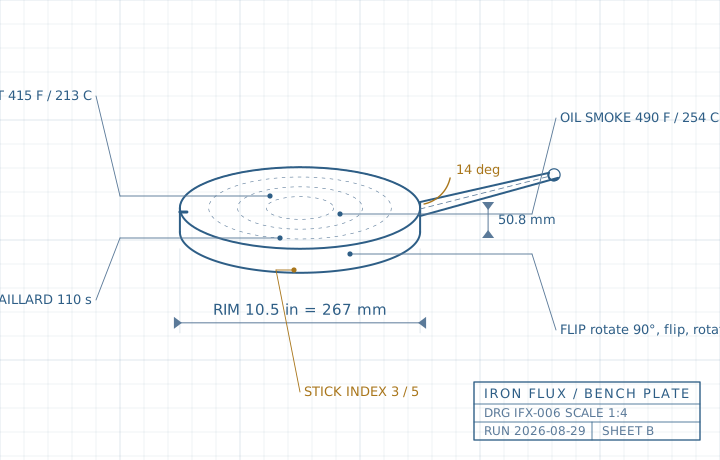
A 28 mm sirloin was seared in a ridged cast-iron grill pan preheated 7 minutes to 415 °F at the ridge crests and 390 °F in the valleys. A 90-degree rotation at 55 s produced the crosshatch, then a flip and a second rotation. Crust coverage was measured by photographing the steak on graph paper and counting browned squares: 41 percent of the surface was browned, against 92 percent for the same steak in a flat 10 in skillet at the same temperature.
02Variables
Independent
- Ridge crest temperature (415 °F) versus valley temperature (390 °F)
- Rotation schedule: 90-degree rotation at 55 s versus no rotation
Held constant
- Steak: 28 mm sirloin, 320 g, room temperature 30 min, surface dried, no salt until after
- Pan: 10.5 in ridged cast iron, 7 min preheat, 1 tsp rice bran oil brushed onto the ridges only
- Burner: gas, 7 of 10, outer ring, pan centred on the ring
- Total pan time 4 min 10 s in both schedules
- Rest 5 min on a rack before measuring
Hypothesis A ridged pan contacts only about a third of the steak surface, so it needs a longer preheat and a higher dial than a flat pan to reach the same crust.
03Process
- Preheat the empty ridged pan 7 minutes, then measure both the ridge crest and the valley with the infrared gun; the two numbers differ by 20 to 25 °F.
- Brush 1 tsp rice bran oil along the ridges with a silicone brush; do not pour oil into the valleys, it will pool and smoke.
- Lay the steak on the ridges at a slight angle and do not move it for 55 seconds.
- Rotate it 90 degrees in place (not a flip) and hold another 55 seconds to build the crosshatch, then flip and repeat.
- Pull at 4 min 10 s total, rest 5 minutes, and count the browned surface before slicing.
04Observations
- The ridge crests measured 415 °F and the valleys 390 °F after the same 7 minutes; the valleys are further from the burner and shielded by the ridges.
- Contact happens only on the 6 mm crest lines: the steak needed 110 s to show colour versus 60 s in a flat pan at the same dial.
- Without the 90-degree rotation the marks were continuous stripes 6 mm wide with pale bands between them, and the crust coverage was 27 percent.
- Fat rendered onto the ridges ran down into the valleys and smoked from 90 s onward, because the valleys stay above 380 °F and hold a pool of fat.
- Cleanup was the worst part: the valley corners trapped a hard, polymerised film that a nylon brush could not lift.
Instrument log
| Point | Surface | First colour | Browned surface | Notes |
|---|---|---|---|---|
| Ridge crest | 415 °F / 213 °C | 110 s | — | 6 mm contact lines |
| Valley | 390 °F / 199 °C | no contact | — | fat pools here |
| With rotation | — | — | 41 % | crosshatch at 55 s |
| No rotation | — | — | 27 % | continuous stripes |
05Conclusion
A ridged pan gives marks, not crust. If what you want is browning, use a flat pan; if you want the marks for a specific dish, accept that you will brown roughly 41 percent of the surface and that the valleys will collect fat and smoke. Two things help: rotate 90 degrees at 55 seconds rather than flipping early, and pour the fat out of the valleys halfway through with a spoon.
Terms used
- Emissivity — How efficiently a surface radiates heat. A dark, seasoned cast-iron surface radiates more than a shiny one, which is why a…
- Maillard reaction — The browning that happens when amino acids and reducing sugars react above roughly 140 °C. It is not caramelisation (which…
- Fond — The browned protein and sugar layer that sticks to the pan during a sear. It is flavour, and it is meant to be dissolved back…