IFX-007 · Flat griddle · Griddle cook
Pancakes on a flat cast-iron griddle: 335, 355 and 385 °F with butter
Butter has a smoke point around 300 °F, yet pancakes cooked in butter at 355 °F taste of toasted milk, not of scorched fat. The difference is contact time and how fast you get the batter in.
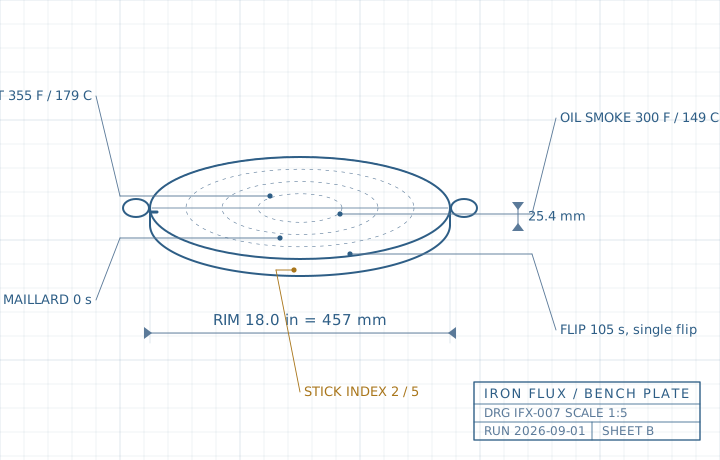
01Abstract
Twelve 60 g pancakes were cooked on an 18 in flat cast-iron griddle at three surfaces: 335, 355 and 385 °F. The griddle was greased with 5 g of butter 20 seconds before each pour. Browning was scored on a five-point scale, butter condition was noted, and the griddle was wiped between batches. The 355 °F surface gave the deepest even colour; at 385 °F the butter went black in under 30 seconds and the pancake edges were bitter.
02Variables
Independent
- Griddle surface temperature: 335 °F, 355 °F or 385 °F
Held constant
- Batter: 200 g flour, 240 g buttermilk, 1 egg, 4 g baking soda, rested 20 min
- 5 g butter per pancake, added 20 s before the pour
- Pour weight 60 g, poured from 10 cm above the surface into the same spot
- Single flip at 105 s; no pressing
- Griddle: 18 in flat cast iron, preheated 8 minutes, wiped clean between pancakes
Hypothesis Butter on a wide griddle browns rather than burns if the surface is held at 355 °F, and the milk solids, not the fat, are what colours the pancake.
03Process
- Preheat the griddle 8 minutes at medium-low, then sweep the surface with the infrared gun in four places; a wide griddle varies by 15 to 25 °F corner to centre.
- Add 5 g butter and let it foam for 20 seconds; the foam should be fine and pale, not brown and noisy.
- Pour 60 g of batter from 10 cm up so it spreads itself; do not spread with a spoon.
- Wait 105 seconds without touching it. Bubbles should break across the whole surface before you flip.
- Flip once, cook 60 seconds more, and wipe the griddle between pancakes so no carbon carries over.
04Observations
- Four-point sweep on the 18 in griddle: 385 °F at the centre, 360 °F at the two side positions, 340 °F at the front corner — the pancake colour followed the map exactly.
- 335 °F: butter foamed quietly for 40 s and the pancake came out pale gold with a soft edge.
- 355 °F: butter foamed, then smelled of toasted hazelnut at 25 s; pancake colour was even across the whole disc and the edge was crisp.
- 385 °F: butter went dark brown at 20 s and black at 40 s; the pancake had a bitter ring 8 mm wide around the edge.
- Residue between pancakes at 385 °F was a black film that needed a scraper; at 355 °F a wipe with a paper towel was enough.
Instrument log
| Surface | Butter at 20 s | Colour score | Edge | Residue |
|---|---|---|---|---|
| 335 °F / 168 °C | pale foam | 3 / 5 | soft | wipe clean |
| 355 °F / 179 °C | nutty foam | 5 / 5 | crisp | wipe clean |
| 385 °F / 196 °C | black | 2 / 5, bitter | bitter 8 mm ring | black film, scraper |
05Conclusion
355 °F is the number for butter on cast iron. The milk solids brown into the flavour you want in about 25 seconds and cross into bitterness at about 40 seconds, so the batter has to be poured immediately after the foam forms. Because a wide griddle is never uniform, sweep it with the gun and pour your pancakes where the reading matches — or preheat longer, since the corner-to-centre spread shrank from 45 °F to 25 °F between 5 and 8 minutes of preheat.
Terms used
- Smoke point — The temperature at which a fat breaks down visibly and starts giving off acrid volatiles. Refined oils sit higher (rice bran…
- Polymerization — The process by which thin films of oil, heated past their smoke point, cross-link into a hard, smooth, bonded layer on iron. That…
- Emissivity — How efficiently a surface radiates heat. A dark, seasoned cast-iron surface radiates more than a shiny one, which is why a…