IFX-008 · 10 in skillet · Bake
Skillet cornbread: preheated fat versus a room-temperature pan
Cornbread in cast iron lives or dies on one minute: the moment between the batter hitting the hot fat and the pan going back into the oven. Get it right and you get a crisp lace base; hesitate and you get a greasy edge.
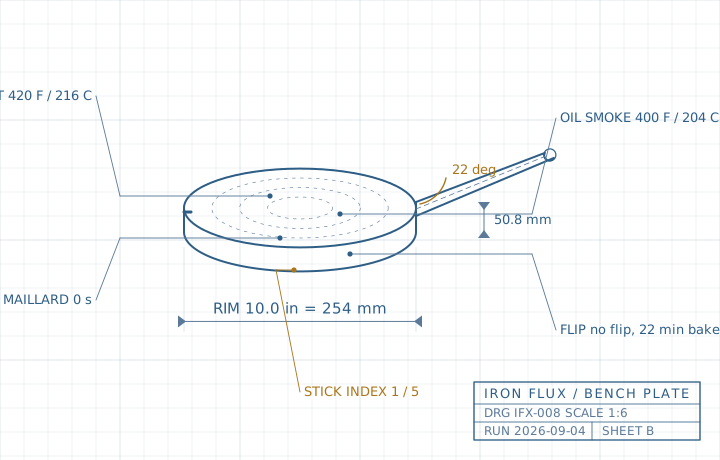
01Abstract
Two cornbreads baked in identical 10 in skillets at 220 °C: one with the pan and 15 g tallow preheated 12 minutes to 420 °F, one with the fat added to a cold pan. Crust thickness was measured at the centre and the edge on a cooled slice, and the crumb was checked for a gummy line. The preheated pan produced a 2.4 mm fried base at the edge and no gum line; the cold-pan version had an even 0.8 mm base and a 4 mm gummy band 1 cm above it.
02Variables
Independent
- Pan and fat preheated 12 minutes to 420 °F versus fat melted in a cold pan
- Pour sequence: batter in within 8 s versus batter left to stand 30 s in the mixing bowl
Held constant
- Batter: 180 g medium cornmeal, 120 g flour, 240 g buttermilk, 1 egg, 6 g baking powder, 4 g salt, 15 g honey
- Fat: 15 g beef tallow, 400 °F smoke point
- Oven: 220 °C, rack middle, 22 minutes, no convection
- Same mixing bowl, same 45 s stir, batter rested 10 min in both cases
- Cooled 20 minutes on a rack before measuring
Hypothesis A 10 in skillet with preheated tallow produces a lacy fried crust on cornbread that a room-temperature pan cannot, without the batter seizing.
03Process
- Put the tallow in the skillet and heat the whole pan in a 220 °C oven for 12 minutes; the fat must be at the smoking edge when the batter arrives.
- Mix the dry and wet ingredients in two bowls, then combine with 45 seconds of stirring — lumps are fine, overmixing is not.
- Pull the pan onto a heatproof surface, pour the batter in from a height of 20 cm aiming at the centre; it should hiss and flare up the sides immediately.
- Return the pan to the oven within 8 seconds and bake 22 minutes without opening the door.
- Test at 22 minutes with a skewer at the centre — it should come out clean but slightly moist — then rest 20 minutes in the pan before cutting.
04Observations
- Preheated version: the batter set on contact and climbed the walls 3 cm, giving a thin fried lace 2.4 mm thick at the edge and a domed top.
- Cold-pan version: the fat melted slowly, the batter spread flat, and a 4 mm gummy band appeared 1 cm above the base.
- Batter standing 30 s in the bowl after the buttermilk touched the baking powder lost lift — the top was 6 mm lower than the 8-second pour.
- The pan was 420 °F at the moment of pouring and dropped to 265 °F within 40 seconds once the batter was in.
- The edge crust pulled away from the pan by itself at 20 minutes of cooling, leaving a clean iron wall behind.
Instrument log
| Version | Pan at pour | Base thickness | Gum line | Top |
|---|---|---|---|---|
| Preheated fat | 420 °F / 215 °C | 2.4 mm at edge | none | domed, +3 cm climb |
| Cold pan | 150 °F / 66 °C | 0.8 mm even | 4 mm band | flat |
| Batter 30 s in bowl | 420 °F / 215 °C | 2.1 mm | 1 mm band | 6 mm lower |
05Conclusion
A cast-iron skillet cornbread is a fried crust with a cake on top, and you only get the fry if the fat is already at 420 °F and the batter goes in the same breath. Twelve minutes of pan preheat at 220 °C is enough for a 10 in skillet; thinner pans need less. The single biggest failure mode is batter standing in the bowl after the leavening is mixed, so have the pan hot, the oven open, and pour within 8 seconds.
Terms used
- Heat capacity — How much heat a pan stores. Cast iron stores far more per litre than aluminium, so it holds temperature when food goes in, but it…
- Fond — The browned protein and sugar layer that sticks to the pan during a sear. It is flavour, and it is meant to be dissolved back…
- Polymerization — The process by which thin films of oil, heated past their smoke point, cross-link into a hard, smooth, bonded layer on iron. That…